Inside Mesothelioma Care: Dr. Jeffrey Velotta on Surgery and Treatment
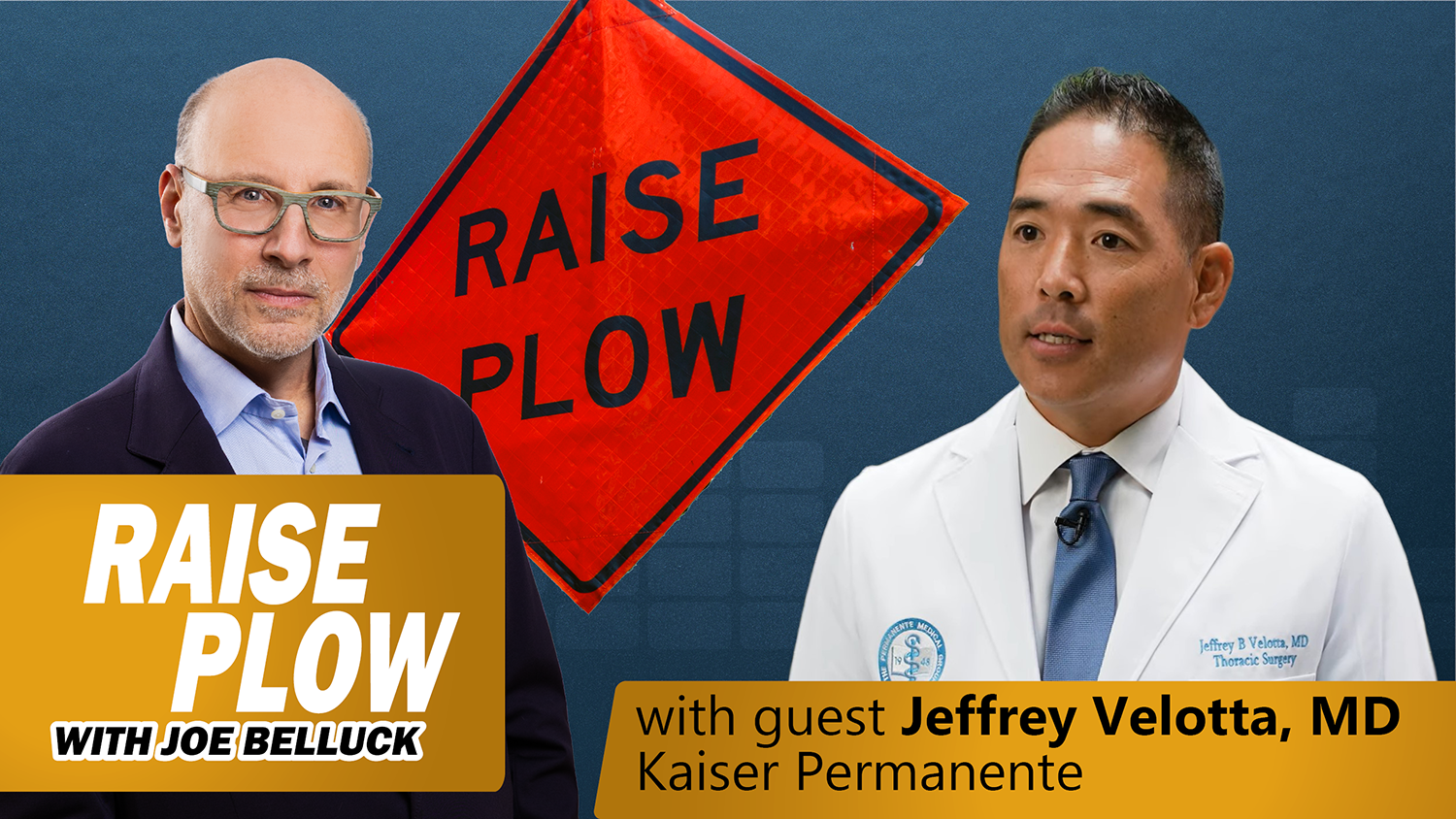
Mesothelioma is diagnosed in roughly 2,000 to 3,000 Americans each year, making it one of the rarest and most technically demanding cancers in thoracic medicine. Dr. Jeffrey Velotta, a thoracic surgeon who leads the mesothelioma surgical program at Kaiser Permanente in Northern California, recently joined Belluck Law‘s podcast Raise Plow to discuss where treatment stands today, including its genuine advances, its unresolved controversies, and the practical realities patients and families face after a diagnosis.
Built on High-Volume Training
Dr. Velotta’s approach to mesothelioma was shaped at Brigham and Women’s Hospital under Dr. David Sugarbaker, long considered the field’s foremost authority. At its peak, the Brigham performed approximately 200 mesothelioma surgeries annually. Surgeons there saw dozens of patients in clinic each week and operated on five to six per week, a volume that simply does not exist at most hospitals. That depth of experience is not incidental to outcomes. Surgeons who encounter mesothelioma once or twice a year cannot realistically achieve the same mastery as those working in dedicated, high-volume programs. Dr. Velotta’s time there gave him both the technical foundation and the clinical perspective that now inform his work at Kaiser, where he co-leads a multidisciplinary tumor board alongside medical oncologist Dr. Jennifer Suga.
Evolution from Lung Removal to Lung Preservation
For decades, the extrapleural pneumonectomy (EPP) was the standard surgical option for eligible mesothelioma patients. The procedure removes the affected lung entirely, along with surrounding pleural tissue and, in some cases, portions of the diaphragm and pericardium. It is aggressive by design, intended to eliminate as much disease as possible in a single operation.
The field has since moved substantially toward pleurectomy and decortication (P/D), a lung-sparing procedure that strips away the cancerous pleural lining while leaving the lung intact. The clinical rationale is straightforward: preserving the lung lowers morbidity, reduces mortality, and improves the patient’s recovery trajectory. Dr. Velotta noted that he has not performed an EPP in several years, a reflection of how thoroughly practice norms have shifted at experienced centers.
Mesothelioma surgery of either type remains among the most technically complex procedures in modern thoracic medicine. Unlike the majority of thoracic operations, which are now performed minimally invasively, mesothelioma surgery still requires large open incisions. Surgeons must dissect tumor from the aorta, the esophagus, the heart, and the lung itself. The difficulty of this work amplifies the importance of receiving care from a team that performs it regularly.
A Trial That Divided the Field
The most contentious development in recent mesothelioma research is the MARS-2 Trial, a randomized controlled study that compared outcomes between patients treated with chemotherapy alone versus those treated with chemotherapy combined with surgery. The trial concluded that surgery did not improve survival and may have been harmful, a finding that led some oncology programs to move away from surgical treatment altogether.
Dr. Velotta and a significant portion of American thoracic surgeons have raised substantial methodological concerns with that conclusion. The trial enrolled patients indiscriminately, including individuals with advanced disease who would not typically be considered surgical candidates at experienced U.S. centers. The reported ninety-day surgical mortality in the study was approximately nine percent, a figure that Dr. Velotta noted stands well above the under-two-to-three percent mortality seen at high-volume programs. Applying results from a study with that kind of mortality rate to the broader practice of specialized centers is, in his view, an overreach. The controversy has not been resolved, but it has had real consequences, reshaping institutional policies and narrowing surgical access for patients who might genuinely benefit.
Combining Therapies for Better Outcomes
Dr. Velotta is direct about the limits of surgery as a standalone intervention. No surgeon credibly claims that removing tumor tissue alone will cure mesothelioma. The operative goal is to reduce the burden of disease as much as possible while setting the stage for additional systemic therapies.
At Kaiser, this translates into a sequential multimodal strategy. Patients who are candidates for surgery receive the procedure first, followed by chemotherapy regimens typically built around cisplatin or carboplatin combined with pemetrexed. Immunotherapy is incorporated for select patients, particularly those with more aggressive disease subtypes. Patients who complete the full sequence tend to achieve the longest survival. The integrated care model at Kaiser, where all treating physicians, hospitals, and nursing staff operate within a single coordinated system, helps ensure that patients move through each phase of treatment without the logistical fragmentation that can compromise outcomes at less connected institutions.
Emerging Intraoperative Approaches
Dr. Velotta is also exploring a newer intraoperative technique involving heated betadine, a solution with demonstrated tumoricidal effects on mesothelioma cells. The approach offers a potential advantage over heated chemotherapy, which has been associated with increased complication rates, while still targeting residual cancer cells at the surgical site. Long-term outcome data is still being gathered, but the technique represents the kind of incremental refinement that characterizes how the field continues to develop between major trial results.
The Financial and Legal Dimension
A diagnosis of mesothelioma carries consequences that extend well beyond the clinical. The disease is causally linked to asbestos exposure, a connection Dr. Velotta described as straightforward: there is a clear cause-and-effect relationship between asbestos and the development of mesothelioma. For most patients, the exposure occurred decades earlier in occupational settings, often without adequate warning or protection.
Treatment costs, travel to specialized centers, and the physical toll of aggressive therapy create significant financial strain for patients and their families. Because most patients face a prognosis measured in years rather than decades, proactive legal and financial planning is genuinely important. Compensation through asbestos trust funds and litigation can provide meaningful support during an extraordinarily difficult period, and Dr. Velotta acknowledged that pursuing that avenue is, from his perspective, a sensible and often necessary step.
The Clearest Takeaway for Patients
Mesothelioma care is at a genuine inflection point. Research is actively evolving, institutional practices differ substantially, and the debate over surgery’s role in treatment continues. Against that backdrop, the most consistent guidance from specialists like Dr. Velotta is straightforward: seek out physicians and centers that treat mesothelioma at high volume, and insist on a personalized treatment plan from a multidisciplinary team. The rarity of the disease means that general oncologists and community hospitals will rarely have the accumulated experience to navigate it well. Finding those who do can make the difference between adequate care and the best available care.
Watch the Full Interview with Dr. Velotta

Free Mesothelioma Patient & Treatment Guide
We’d like to offer you our in-depth guide, “A Patient’s Guide to Mesothelioma,” absolutely free of charge.
It contains a wealth of information and resources to help you better understand the condition, choose (and afford) appropriate treatment, and exercise your legal right to compensation.
Download Now